|
A Brief History of Bulgogi |
|
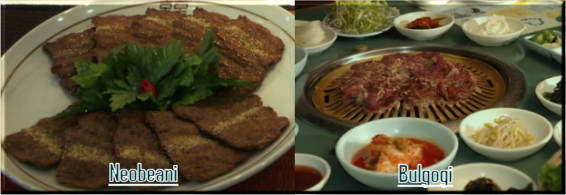
Koreans are probably descended from a nomadic people known as the eastern barbarians of Maek, who migrated eastward from central Asia into Northeast Asia and the Korean peninsula. The Maek people brought with them a meat dish, Maekjeok, that differed from the typical meats cooked and eaten by the Han Chinese of that time. The meats cooked by the Han people were generaly seasoned after cooking, while Maekjeok was seasoned before being skewered and roasted. Maekjeok nearly disappeared after the introduction of Buddhism to the Silla and Baekje Kingdoms that dominated most of Korea just over one thousand years ago. These two Kingdoms banned meat eating for several centuries, so Maekjeok was relegated to several small tribal areas outside the kingdoms. The Mongol invasions ended the proscription against eating meat and Maekjeok, now called Seolhamyeok, again spread throughout Korea. The method of seasoning chunks of skewered meat then roasting over open flame or hot coals eventually morphed into seasoned thin cut meats being cooked on metal plates placed over hot coals. These cuts of meat are similar to steak cuts, but thinner, and became known as Neobiani.
Meat for Neobiani is cut into flat steak like sections approximately 1/2 inch thick, tenderized with the tip of the knife then marinated, and was typically cooked in a kitchen or area away from the table. Bulgogi developed from this dish with the introduction of cooking vessels, perforated metal plates placed over a small container of coals, that could be placed on or near the table. This allowed for even thinner cuts of meat which could be eaten directly from the grill plate without much loss of flavor due to cooling. This meat preparation became known as "Fire Meat" or bulgogi as it is known today. |
- MENU

- Home
- Korean Store Locations
- Entertainment
- Banchan/Snacks
- Bokkeum 볶음
- Kimchi 김치
- Baechu Kimchi 배추김치
- Baechu Kimchi 배추김치 2
- Beulokolli Mulkimchi (브로콜리 김치)
- Bossam Kimchi (보쌈김치 )
- Chonggak Kimchi (총각김치)
- Dongchimi 김치 3
- Gochu Kimchi (고추김치)
- Kkaenip Kimchi (깻잎 김치)
- Kkakdugi (깍두기)
- Mul Kimchi (물김치)
- Nabak Kimchi (나박 김치)
- Nabak Kimchi (나박 김치) 2
- Oisobagii (오이소박이)
- Pa Kimchi (파김치)
- Yeolmu Mul Kimchi (열무 물김치)
- Jangajji 장아찌
- Jeon 전
- Beoseotjeon (버섯전)
- Daegujeon (대구전)
- Dubujeon (두부전)
- Dwaejigogi_jeon (생선전)
- Gajijeon (가지전) 1
- Gajijeon (가지전) 2
- Gamjabuchim (감자전/감자부침 )
- Gamjajeon (감자전) 1
- Gamjajeon (감자전/감자부침개) 2
- Gogi Jeon (고기전)
- Haemul Pajeon (해물파전)
- Hobakjeon (호박전 ) 1
- Hobakjeon (호박전) 2
- Kimchijeon (김치전/김치부침개])
- Nokdu Bindaetteok (녹두빈대떡)
- Paengee beoseot jeon 팽이전
- Pajeon (파전)
- Saengseonjeon (생선전)
- Jeotgal 젓갈
- Jorim 조림
- Namul 나물
- Saengchae 생채
- Other
- Snacks 1
- Snacks 2
- Snacks 3
- Main Dish
- Soups&Stocks
- Royal/Temple Dishes
- Royal Dishes
- Ddeokjjim (떡찜)
- Dubujeongol (두부전골)
- Gujeolpan (구절판)
- Gungjung Ddeokbokki (궁중떡볶이)
- Gunjung Japchae (궁정잡채)
- Palbochae (팔보채)
- Seollung Tang - A Royal Soup
- Sinseollo - Food of the Mountain Gods
- Soondae (Korean Blood Sausage)
- Tteokkaibi/Tteokgalbi
- Tteokkaibi - Short Rib Meat Patties - Version 2
- Tteokkaibi - Short Rib Meat Patties - Version 3
- Yuk Hoe (Seasoned Raw Beef)
- Temple Dishes
- Royal Dishes
- Fusion Dishes
- Beulokolli Mulkimchi (브로콜리물김치)
- Beef and Tortilla Wraps
- Brocoli Salad Korean Style
- Bulgogi Sandwich
- Dakkaseu 닭까스
- Dak Tako (닭 타코)
- Donkkaseu (Pork Cutlet)
- Easy Korean Pork Buns
- Galb/Kalbi "Steak" Sandwich
- Kalbi Burger
- Kimchi Bread Sticks
- Kimchi Burger
- Kimchi Omelet
- Kimchi Stuffed Pork Chops
- K-Quesadilla
- Maeun Soegogi Saelleodeu (매운 쇠고기 샐러드)
- Ribbon Meat Skewers
- Rice Paper Wraps
- Korean Grilled Chicken Sandwich
- Fusion - Spicy Grilled Pork Sandwich (Maeun Dwaejigogi-saendeuwichi)
- Spicy Korean Inspired Pork Spareribs
- Spicy Pork Breakfast Wraps
- Condiments
- Beverages
- Non Korean Recipes
- Commercial Sized Recipes
- Bases and Sauces
- Cashew Sauce (Chinese)
- Chicken/Pork Marinade (Chinese)
- Barbeque Sauce (Chinese)
- Chinese Brown Sauce
- Chow Mein Base Sauce
- Fried Rice Base (Chinese)
- Garlic Sauce (Chinese)
- General Tsao Sauce
- Mandarin Sauce (Chinese)
- Marinated Beef
- Marinated Chicken
- Satay Sauce
- Spicy Fried Chicken Base (Chinese)
- Teriyaki Sauce
- White Sauce (Chinese)
- Beef Dishes
- Chicken Dishes
- Bases and Sauces
- Slide Show Recipes
- Info/History
- Food Information
- Some Korean Cooking Notes
- A Note about Korean Cooking
- A Brief Introduction to Korean Food and Culture
- About Kimbap
- About Namul
- About Ssam
- Basic Ingredients
- Endangered Seafood
- Glossary
- Ingredients
- The Basics
- Weight Equivalents
- Weight Equivalents - Almonds
- Weight Equivalents - Ambrosia Melon
- Weight Equivalents - Apples
- Weight Equivalents - Apricots
- Weight Equivalent - Banana
- Weight Equivalents - Asparagus
- Weight Equivalents - Blueberries
- Weight Equivalents - Broccoli
- Weight Equivalents - Cabbage
- Weight Equivalents - Cantaloupe
- Weight Equivalents - Casaba
- Weight Equivalents - Cauliflower
- Weight Equivalents - Cherries
- Weight Equivalent - Chili peppers
- Weight Equivalents - Chives
- Weight Equivalents - Mushrooms
- Weight Equivalents - Eggs
- Weight Equivalents - Garlic
- Weight Equivalents - Grapefruit
- Weight Equivalents - Green Onions
- Weight Equivalents - Greens
- Weight Equivalents - Honeydew
- Weight Equivalents - Lemon
- Weight Equivalents - Lettuce
- Mushrooms
- Weight Equivalents - Asian (Nashi) Pear
- Weight Equivalents - Onion
- Weight Equivalents - Orange
- Weight Equivalents - Peaches
- Weight Equivalents - Pears
- Weight Equivalents - Peas.
- Weight Equivalents - Pineapple
- Weight Equivalents - Plums
- Weight Equivalents - Potato
- Weight Equivalents - Radish
- Weight Equivalent - Raspberries
- Weight Equivalents - Burdock Root
- Weight Equivalents
- Weight Equivalent - Strawberries
- Weight Equivalents - Spinach
- Weight Equivalents - Tomato
- Weight Equivalents - Watermelon
- Korean Food History
- Food Information
- Home
- Pantry & Equipment
- Government Job Links